


Accessible Tabletop Games for Blind, Low-Vision & Sighted Players
2Play Games creates tabletop games designed from the start for blind, low-vision, and sighted players to enjoy together.
We believe great games should be engaging, intuitive, and accessible to everyone at the table.
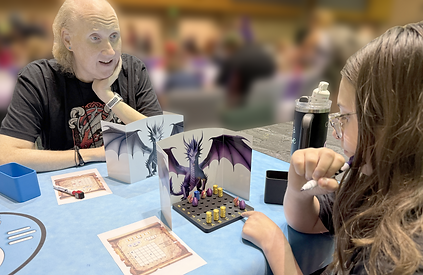
A young girl plans her next move for the Dragon's Nest game. She points at the black game board with the brightly colored tactile game pieces.
Equal-Play Game Design™
This is our foundation. We strive to create games where all players, no matter their level of vision, can play together on equal terms - using the same rules, components, and information, without special adaptations. Our games are conceived from the beginning around the goal of equal play between blind and sighted players.
Our Featured Game

Accessible game design is good game design!
The concepts and components that go into an accessible game are good for all players! We play test extensively: at conventions for the blind, at low vision summer camps for children, and gaming conventions for the sighted.
Our blind and low vision play testers love the tactile nature of our games.
Our sighted play testers also appreciated the colorful high contrast designs.

Players testing Fate and Fortune at the National Federation of the Blind convention. They loved betting on the fate of their rivals!
Here's a nice interview discussing our game design philosophy and some of our games.
Frequently Asked Questions
Can blind, low-vision, and sighted players play the same board game together?
Yes. When accessibility is considered from the beginning, blind, low-vision, and sighted players can play the same game together. The key is making important game information available without relying on sight alone. Tactile components, identifiable shapes, thoughtful organization, and accessible game mechanics can allow players to make their own decisions and play independently. At 2Play Games, our goal is not to create a separate version of a game for blind players, but to design one game everyone can enjoy together.
Do accessible board games need Braille?
Not necessarily. Braille can be an effective way to make some game information accessible, but many low-vision people do not read Braille. Many older adults have trouble learning Braille, or may have reduced fingertip sensitivity, making Braille more difficult to read.
Information can also be communicated through distinctive shapes, textures, tactile symbols, position, orientation, and other physical features.
We don't automatically add Braille to make a game accessible. We first ask what information a player needs, and look for the simplest, most intuitive way to make that information available without relying on sight.
2Play Games uses Braille when it is the most effective solution for younger players, who mostly know Braille.
What makes a board game accessible to blind and low-vision players?
An accessible board game provides players with the information they need without requiring them to rely solely on vision or assistance from another player. This can include tactile components, distinctive shapes and textures, clear organization, strong visual contrast, and game mechanics designed with accessibility in mind. Accessibility is about more than modifying individual components. The way information is presented, how choices are made, and the how game itself functions can all affect whether blind and low-vision players can participate independently.
How can tabletop games provide information without relying on sight?
Tabletop games can communicate information through touch, shape, texture, position, orientation, tactile markings, Braille, and sometimes sound. A piece's physical shape might identify what it does, while its location on a board can communicate other information. The important question is not simply, “How do we make this tactile?” but, “What information does the player need to make a decision?” Good accessible game design finds an intuitive way to provide that information without requiring sight.

